Look… I need to get this out of the way. I’m not a “Halloween person.” I don’t believe I have dressed in costume since middle school. I don’t decorate our home or look forward to the happenings of the day. Just hasn’t ever been my thing. (I’m not trying to impress you… but am I?)
But Halloween music – I do really enjoy Halloween music. I generally gravitate toward dark music: metal, darkwave, noise, etc. But Halloween music is something different. Almost by its nature it needs to be more accessible (sorry Dominik Fernow!) and touch on some element of fun/pop/quirk. That was a terrible description… but it’s hard to describe. I’d love to leave it at US Supreme Court Justice Stewart’s description of pornography (“I know it when I see it“,) but that seems both unfun and unfair.
So let’s make a mixtape… but first let’s lay down some rules!
The Absolute Rules
Only accessible music: while powerelectronics, death metal, and soundtracks all might seem to fit the theme, look for something more party-worthy
Halloween vibes come first: AC/DC’s Hells Bells is a good example – it’s more Friday Night Lights jock jam than Halloween hit
A good title does not a Halloween song make: Hungry Like The Wolf? Sympathy For The Devil? Moondance? None of these has the Halloween vibe
This is a mixtape: no repeat artists and a diversity of genres; all apologies to Roky Erickson, the Misfits, and the Cramps
Some Additional Guidelines
There is no 1 vibe: it can be fun (Monster Mash!) or be a pop song (Thriller!) or be dark (goth!) or … or … or … look, you get the point; there is no single “vibe” to look for, it just needs to wholly encompass some element of Halloween
Kitsch is kosher: no reason to avoid songs that might be gauche, cringe-y, or unhip the other 355 days… this is Halloween! Everything is artifice! If you really need to explain yourself, irony is a flat circle and you’ll do fine.
90 minutes: no self-respecting mixtape-maker went with a 60 minute tape and the 120 minute tapes were unreliable
Our 90-Minutes Of Halloween
Our playlist is below… enjoy! Leave your suggestions in the comments.
After a long and possibly unhealthy relationship with iTunes ended – or at least started it’s long decline – this fall, I am caught reflecting on how my music consumption has changed over the years. It’s an interesting journey. I typically think of my musical evolution along the axis of my musical taste. And while the changes in my consumption take cues from taste, they are just as influenced by technology, income, and everything else happening in my life.
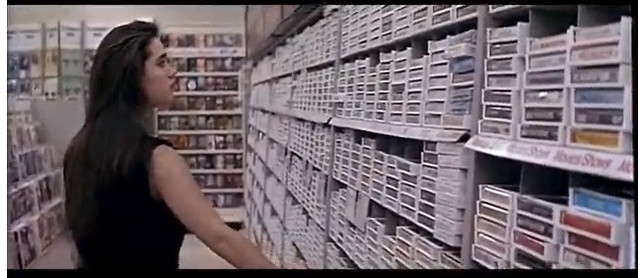
The Department Store Cassette Aisle
My earliest memory of engaging with music is in the department store. I was early Elementary aged and MTV was a primary source of inspiration. Europe, Whitesnake, Def Leppard, and others offered a quick shot of adrenaline. It’s not completely clear to me why this was the music I loved at the time – but this was definitely what I sought.
As an Elementary-aged kid in the 1980s, there was nothing which I look back and see as evidence of an undying love for listening to music. Other curiosities demanded more of my limited allowance and gift monies (e.g., Nintendo.) I was not inspired to make music. Rather, every odd trip to the local K-Mart, Target, or Wal-Mart would find me wandering to the cassette aisles to find a familiar rock album and convince my mother to let me use my allowance.
The first cassette tape I remember purchasing with my own money was Europe’s The Final Countdown released in May of 1986.
I did develop one trait at this time that has carried on through today: an interest in the album over the hits. When I chose to listen to music on my own time, I was typically in my room, listening one of my tapes rather than the radio, and devoting my full attention to the cassette player. Each song on the album carried equal weight and I felt it was my duty to give attention to all of them. I’m not sure why I did this. Did I just think “this is how you are supposed to listen to a tape?”
Mall Rats: Camelot, Musicland, Sam Goody
I’m not sure exactly when or why – it was probably heavily influenced by my big sister and MTV, alike – but this more passive participation in music transitioned to an active identity-seeking in middle school. I’d like to say that my forays into hip hop, alternative music, and metal started with some noble quest for identity and truth in art. Candidly, I think I was just an angry young man. I participated in any statements as witness – I was only there for the f-words, snarls, and shouted anthems.
This phase roughly coincided with my purchase of a CD player and therefore my first CD purchases: Soundgarden, Public Enemy, the Beastie Boys, and N.W.A. At this time I was also starting to seek out the purchase of music. Friends and I would go to the mall and make sure we hit the 2 music stores. We’d flip through the CDs (as if they changed over frequently) and the t-shirts.
Apart from the increasing percentage of my allowance allocated to music, this period also saw me start to make mix tapes (err, “playlists” for the kidz.) It was so easy to dub music from a CD to a tape and it wouldn’t be until much later that I would get a portable CD player.
Fort Worth, Y’all: CDx and The Engine Room
Later in middle school and throughout high school it seemed that music pushed past other interests and would become my chosen “identity.” I devoted an ever-increasing share of my income to music, starting choosing my friends based on their musical tastes, and transitioned my wardrobe to almost only band shirts. I had plenty of other hobbies and commitments pulling at me – I played a few sports, skateboarded, was decent at school, and worked 20-40 hours a week after turning 16 – but it was music that I chose as my “face” to the world. I am probably still the only player for my high school baseball program who has ever worn Morbid Angel t-shirts to practice.
The evolution of my musical tastes in this time period is probably less of the story. I continued to seek angry music, going a little deeper into genres. NIN became Ministry which became Godflesh. The Ramones became Exploited which became Crass. Megadeth became Sepultura which became Carcass. And so on and so forth.
Despite how obsessively focused on the music I was in middle/high school, it wasn’t the interesting evolution. The real story was how I was consuming and interacting with music. I purchased a guitar and played in a few bands. I started attending shows – and got hooked. And it was at these shows that I began to purchase and listen to records.
The first show I attended was at a bar in Nashville when I was 14. My best friend and I were visiting his aunt and she convinced the staff to let us in to see Valentine Saloon. They played some grunge-y version of Sonic Temple worship. The music was good – but the experience of being in such a small, dark venue with the music so unbelievably loud was captivating. I spent the next 4 years going to every show I could.
When you go to shows, you buy merch – bands depend on merch sales for touring cash. And when you buy merch at shows, you look for items which you cannot get elsewhere. The t-shirt is the staple, but quickly I realized that show merch tables were a great place to find rare records (remember this was pre-internet.) Thus began my infatuation with records – especially the 7″ single.
Naturally, I sought local stores in DFW who sold new records. There was Bill’s in North Dallas and the various Deep Ellum stores. But there was also a weird little store in a strip mall off highway 183 named CDx. It seemed to start as a run-of-the-mill used+new CD store, but the owner/manager was a hip guy and they quickly stocked plenty of records, as well. CDx was a regular stop.
KVRX And Sound Exchange, A Quick Note
My 4 years in undergrad were a wonderful time. And while my musical horizon expanded, my music collection exploded, and I met my wife at a Sebadoh show, not a whole lot changed in my consumption of music. I bought a lot of weird records at Sound Exchange on the drag in Austin- especially 7″ singles. I saw a lot of shows (and wore a lot of band shirts.) I did trade playing music with a band for playing music on the radio at KVRX 91.7 FM. More iteration than evolution.
Al Gore, Lars Ulrich, And Steve Jobs Walk Into A Bar…
After spending three years in a professionally overworked blur, I moved to NYC in mid-2003. This catalyzed a sea change in my relationship with recorded music. First, my listening radically changed from a largely physical experience in Texas (records at home, CDs at work, cassettes in the car) to a largely digital experience in NYC. In a world of city streets, subways, and graduate school classrooms, I needed my music mobile. You might recall this change in needs also corresponds neatly with a consumer device which was on its 3rd generation and a file sharing community which had long left Napster behind.
While not a reality until this flight, the ion drive-powered aircraft has long existed in science fiction. It has been linked to Donald Horner’s By Aeroplane to the Sun: Being the Adventures of a Daring Aviator and his Friends published in 1910 and Jack Williamson’s The Equalizer published in 1947. The internet told us this — we have not read the books. Point being, ion drive technology has captured the imagination for a long time.
In 1964 the seeming first attempt to deploy an ion drive was launched via the SERT-1 satellite by NASA. It was sent into space via a Scout rocket. Once in space, it activated a Kaufman ion thruster successfully! The ion drive was active for **checks notes** 31 minutes and 16 seconds. More in-flight sitcom than movie.
Piggybacking quickly on this obvious success, NASA sent its Deep Space 1 project into space in 1998. The mission had a lot going on — 12 objectives and a flight path the was to buzz past an asteroid. The ion drive failed initially, but was restored and succeeded in its objective.
“Sorry Goose… but it’s time to buzz the tower”
The Chief Mission Engineer for the Deep Space 1 was Dr. Marc D. Rayman. In a New York Times article from 1998, Dr. Rayman says he “first heard of ion propulsion in 1968 during a Star Trek episode.” With the promise of a more efficient mode of travel, he predicted at the time that ion drive travel ”has the potential to change everything.” The successful MIT flight is another step in that direction.
While we certainly want to avoid wading into the Star Trek versus Star Wars food fight, it does appear that the most well-known ion drives are not driven by Captain Kirk or NASA. Rather, Darth Vader’s fleet of TIE Fighters are powered by this technology and the TIE acronym itself stands for Twin Ion Engine. The TIE Fighter was famously given its sound by Ben Burtt (Lucas’ own sci-fi DJ Screw) by slowing down and mashing up elephant screams and car tires. It’s not clear how those smart engineers at MIT plan to emulate this critical element of the ion drive’s transition from fiction to fact.
Santo & Johnny’s “Sleep Walk” Ended #11 On Billboard’s Hot 100 In 1959
It cannot be that starting with the Billboard Hot 100 is the best way to get a sense for a year’s musical pulse, can it? Probably not… but this is where we are starting. And in taking a tour through the Hot 100 for 1959, there are a number of songs which are pleasures, treasures, and surprises. But there are far more which just make you feel like you are on a long drive with your grandparents…
The list has an interesting mix of songs rooted in the past and looking to the future. Some tracks do both — like the unique-for-the-time steel guitar of “Sleep Walk.” Some straddle genres, like the R&B stomp of “Charlie Brown.” But mostly the list seems like a year of popular music stuck in the past of crooners or lyric folk, without any of the the rock ‘n’ roll explosion of what would come.
The treasures
Santo & Johnny’s “Sleep Walk” is #11 on the list and was said to be written by the Brooklyn brothers Farina late one night when sleep was elusive. The song’s melody and steel guitar make it sound both fresh and classic, simultaneously. Lyrics were written for the song, but ultimately scrapped. We agree.
A few spots down the list at #17 is The Coasters’ single “Charlie Brown.” The song is a catchy hybrid of caveman rock and doo-wop and has the hilarious and infectious line “why is everybody always pickin’ on me?” King Curtis comes in for a tenor saxophone solo. It should be noted that the song is not a reference to the Peanuts comic strip.
This site is intended to be a diverse collection of ideas from a revolving cast of folks. We could offer up some central themes to “define” the site, but we’d rather let you stumble into your own view… or not.



 La Hora Del Burro